Dupuytren's disease & drug repurposing
How the disease works
How Dupuytren's starts and gets worse, what's happening in the cells, and what the genetics tell us.
Why it’s usefulIt explains why timing matters: a drug would most likely need to be given early, before a finger is stuck in a bend.
Nodule → cord → contracture Interactive
Schematic, not to scale. Digits 4 and 5 are most commonly affected; flexor tendons and muscle are not involved PMID 34225446.
The cells a drug would target are busiest early, in the nodule. By the time a finger is fixed in a bend, many of them have gone. So a drug would most likely need to be given early PMID 19910144.
How a fibroblast becomes a myofibroblast Animated
The genetics
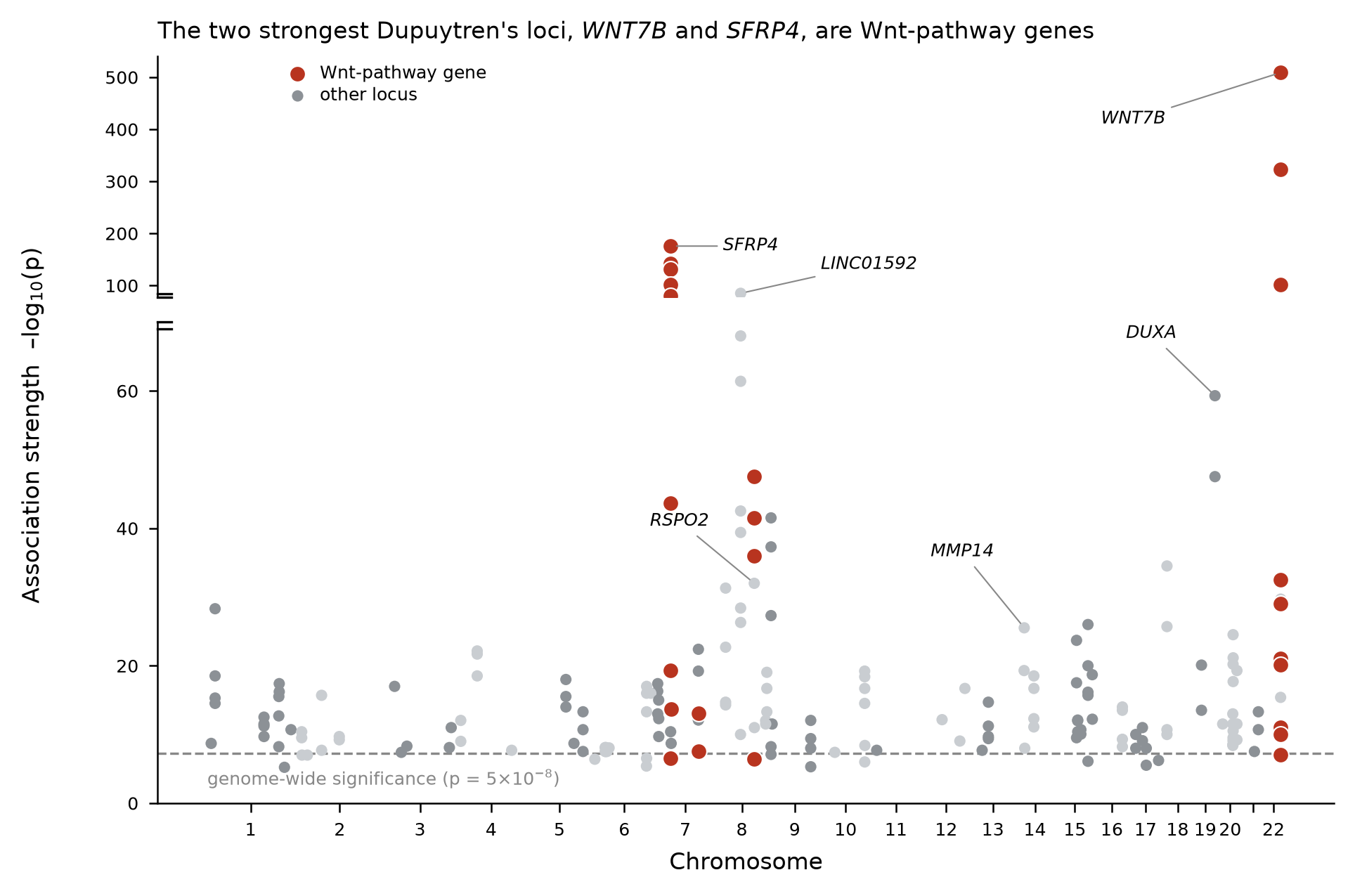
The genetics point most strongly at Wnt signalling, a set of proteins that control how cells grow. The first large study found nine loci; six contained Wnt-pathway genes, including the two largest effects in the literature, SFRP4 (OR 1.98) and WNT7B (OR 1.54) PMID 21732829. WNT7B has since replicated in a North American cohort PMID 39570219.
One gene has a clear explanation. A common MMP14 variant leaves the enzyme with 17% of its normal collagen-cutting activity. That means the body is worse at clearing collagen away, which is a different problem from making too much of it. About 30% of people worldwide carry at least one copy PMID 33592276.
The popular idea that Dupuytren's is a "Viking disease" doesn't hold up: tests for extra Norse ancestry found none PMID 31663799. Three of 61 risk regions do carry DNA inherited from Neandertals, including the second and third strongest PMID 37315093.
None of the strongest genetic targets has a drug yet. SFRP4, WNT7B, EPDR1 and MMP14 have no approved drug, and studies disagree about which way SFRP4 pushes the disease PMID 28886342 PMID 36719100.
Which risk factors actually cause it?
Observational studies show what goes along with Dupuytren's. Mendelian randomisation uses genetics to test whether a risk factor actually causes it. The two don't always agree.
| Exposure | Mendelian randomisation | Sources |
|---|---|---|
| Long-term high blood sugar | Supports causation OR 1.17 per 10 mmol/mol HbA1c | PMID 32970002PMID 38205890 |
| Alcohol | Supports causation in two studies | PMID 37679690PMID 42608758 |
| Smoking | Not supported in two studies | PMID 41092106PMID 37679690 |
| Higher body-mass index | Inverse, unexplained OR 0.94 per 5 kg/m² | PMID 38205890PMID 34906131 |
| Manual work and vibration | Cannot be tested not genetically instrumentable | PMID 39317441PMID 36635095 |